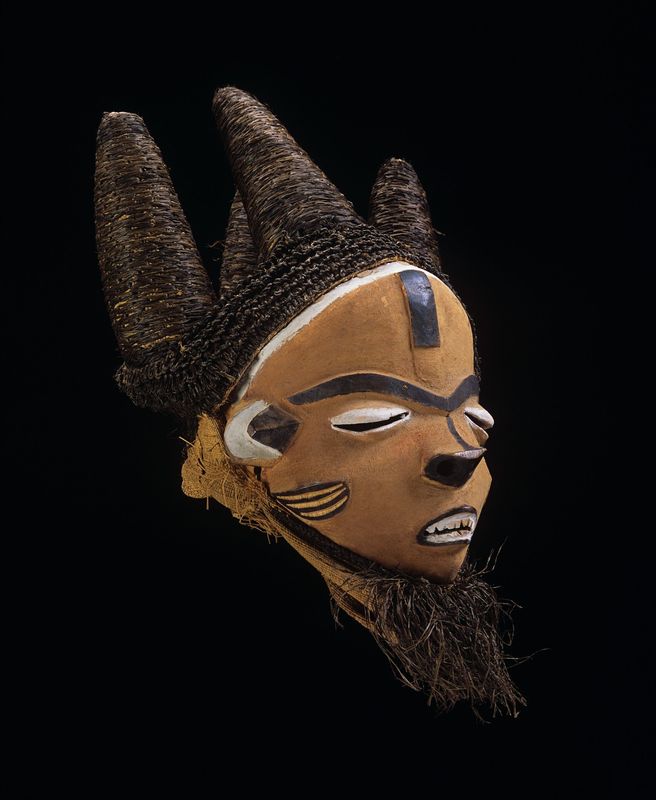
Mask (mbuya) representing a chief (fumu) (Central Pende) - Artist: Gabama a Gingungu - EO.0.0.32128
1st quarter of the 20th century (1920s). RD Congo. Registered in 1930. Donated by W. Retivof (through Pierre Golenvaux).
In the 1980s, the American art historian Z. Strother followed in the footsteps of Olbrechts. Through fieldwork and discussions with contemporary artists, she managed to reconstruct the biography of several Pende sculptors.
Based on photographs of the mask shown here, and on the basis of shape and technique, the Pende artists that she interviewed formally recognized the hand of Gabama a Gingungu (1890?-1965). He would have made the mask in the 1920s. Several sculptors immediately identified this piece as the work of Gabama based on iconographic and stylistic details, such as the pyramidal tragus of the ear, the hairstyle, or the upturned nose with large nostrils. The sculptors from the 1980s could still remember this famous artist, and considered him the best of them all.
Gabama a Gingungu, born in the Nyoka-Munene region, learned his craft from his uncle Maluba (1870?-1935) — a renowned artist in his own right, who, however, was quickly outclassed by his nephew. After a while, dancers preferred to commission their masks from Gabama than from Maluba. In the space of a few years, Gabama’s reputation spread throughout a large part of the Pende area, and the commissions poured in. From the 1930s, he also developed an effective sales strategy by travelling through villages in the region, looking for customers. He remained active as a sculptor until the end of his life, but from the 1950s, he concentrated on ikhoko, small masks that were worn as pendants. These were easier to craft as his body grew weaker with age.
